Table of Contents
- Why Yoga Matters During Menopause
- Menopause Yoga Poses for Strength and Bone Health
- Beginner Yoga Routine for Menopause
- Best Exercises for Menopause Weight Management
- Yoga for Menopausal Belly Fat and Metabolism
- Symptom Relief Through Restorative Poses
- Getting Started: Frequency, Duration, and Progress
- Frequently Asked Questions
Last Updated: October 6, 2026
Why Yoga Matters During Menopause
Menopause brings real physical changes. Your metabolism shifts. Hormones decline. Weight tends to accumulate, especially around the belly. Many women find that approaches that worked before simply stop working.
Yoga poses for menopause weight management offer a practical path forward. Yoga combines strength-building with stress relief, two things that directly impact weight during this life stage.
This guide walks you through the specific poses and routines that address the challenges of menopause.
The real advantage of yoga during menopause isn’t just calorie burn. It’s the combination: you build muscle to support metabolism, reduce cortisol through gentle movement, and improve sleep quality, all factors that influence weight.
Start where your body is, not where you think it should be. Modifications matter more during menopause than at any other life stage. Your joints need support. Your pelvic floor needs attention. A properly modified pose beats a perfect-form pose that leaves you sore.
Menopause Yoga Poses for Strength and Bone Health
Strength and bone density are non-negotiable during menopause. As estrogen drops, bones lose density faster (Osteoporosis Due to Hormone Imbalance). Muscle mass declines naturally. Weight-bearing and resistance-based poses directly counter both trends.
The poses that matter most are ones that load your spine, hips, and legs. These areas face the greatest bone loss. Weight-bearing poses force your bones to work, which signals them to maintain density.
Weight-Bearing Poses
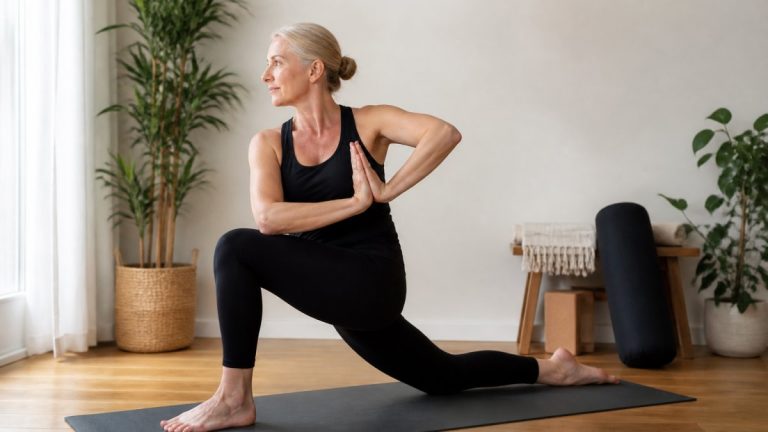
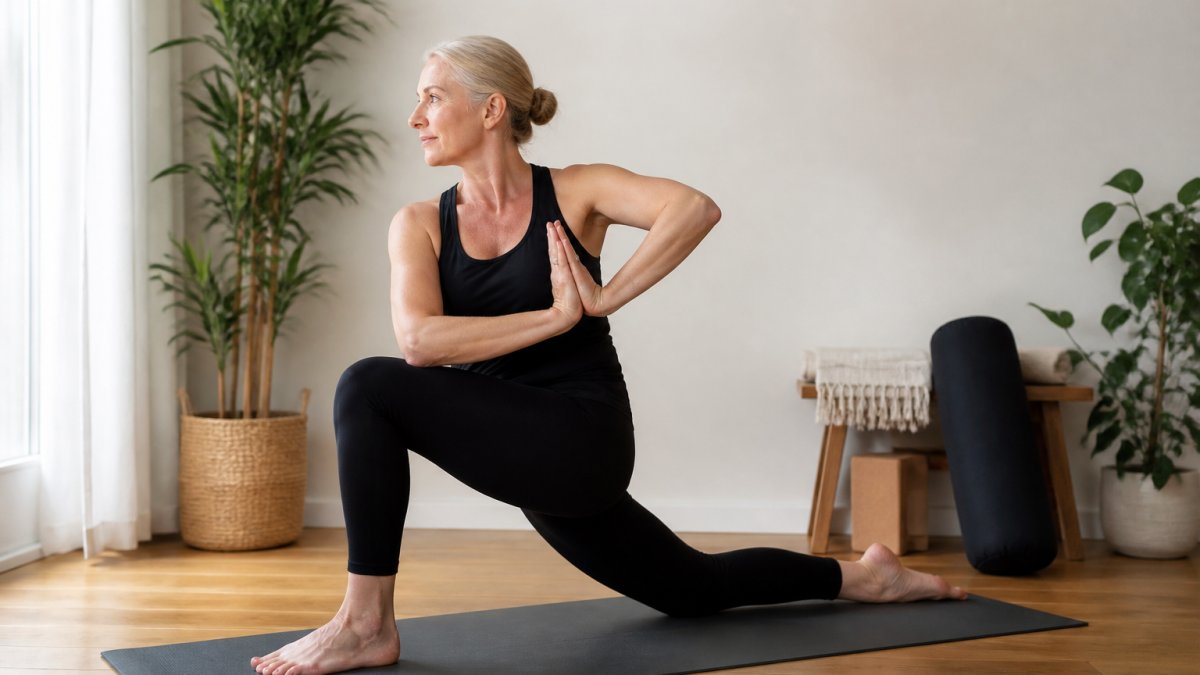
Warrior I and II build leg strength while loading the hip and spine. Hold each side for 30-60 seconds. The front knee stays over the ankle.
Tree Pose improves balance and engages the standing leg intensely. Press your foot into the inner thigh or calf of the opposite leg. Keep your chest open.
Chair Pose is one of the most effective strength builders. Lower your hips as if sitting into a chair. Weight stays in your heels. Knees track over ankles.
Mountain Pose seems simple but it’s foundational. Stand with feet hip-width apart. Press all four corners of your feet into the mat. Engage your thighs.
Supported Poses for Joint Comfort
Joint stiffness increases during menopause. Inflammation markers rise as estrogen drops. Supported poses reduce strain while building strength.
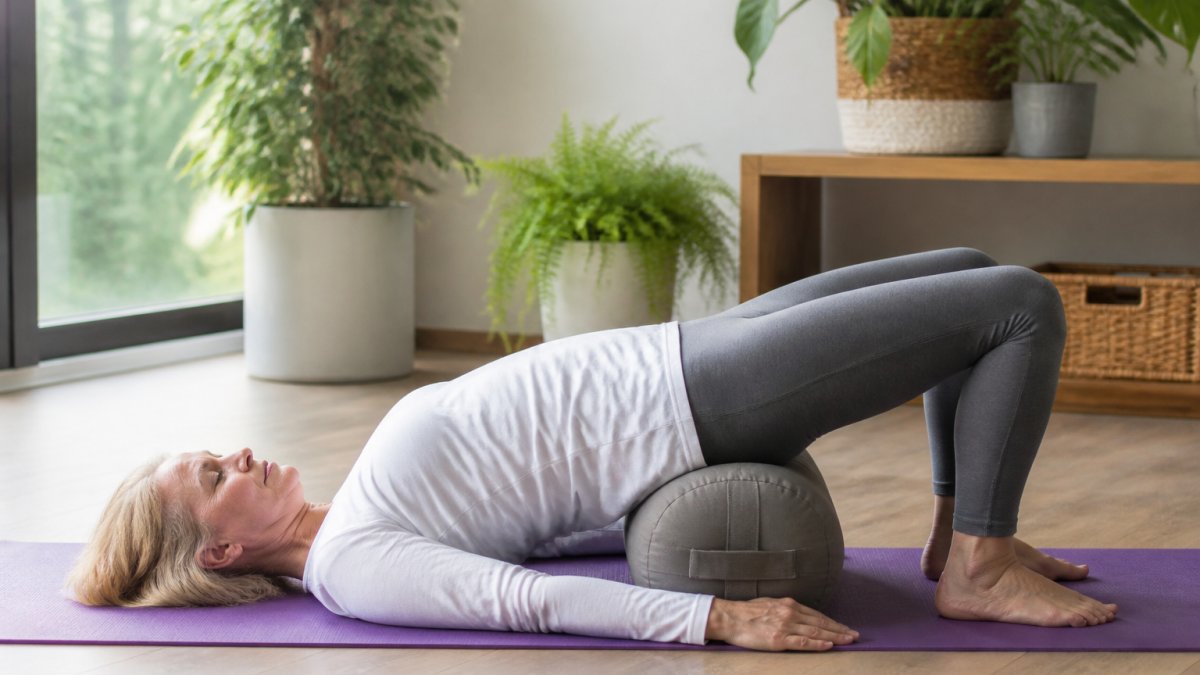
Supported Bridge Pose engages the glutes and hamstrings without stressing the lower back. Lie on your back, knees bent, feet hip-width apart.
Reclined Butterfly opens the hips gently. Lie on your back, soles of feet together, knees falling open. You can place blocks under your knees for support. Hold 1-2 minutes.
Supported Child’s Pose offers gentle spinal flexion. Kneel, big toes together, knees wide. Fold forward and rest your forehead on a block or pillow. Arms extend forward.
Beginner Yoga Routine for Menopause
A 20-minute routine hits the essential poses without overwhelming your schedule. Consistency matters more than length. A short routine you do four times per week beats a long one you do once.
Sample 20-Minute Sequence
- Mountain Pose (1 minute), Ground yourself. Press all four corners of your feet down.
- Cat-Cow (2 minutes), Warm your spine. Move slowly. Coordinate breath with movement.
- Downward Dog (1 minute), Build shoulder and arm strength. Feet hip-width apart. Hands shoulder-width.
- Warrior I (1 minute each side), Load your hips and legs. Breathe steadily.
- Warrior II (1 minute each side), Strengthen and open the hips. Gaze over your front fingertips.
- Chair Pose (45 seconds, rest 15 seconds, repeat), Maximum strength in minimal time.
- Tree Pose (30 seconds each side), Balance and focus.
- Supported Bridge Pose (1 minute), Glute and hamstring activation.
- Reclined Butterfly (2 minutes), Hip opening and relaxation.
- Supported Child’s Pose (2 minutes), Nervous system calm.
This sequence takes 20 minutes. It hits strength, balance, and flexibility. Do it four times per week for consistent practice.
Modifications for Different Fitness Levels
If you’re new to yoga or have joint issues:
- Use a block under your hands in Downward Dog
- Hold the wall in Warrior poses for balance support
- Skip Chair Pose initially; build to it over 2-3 weeks
- Use blocks under your knees in Reclined Butterfly
- Shorten hold times by 50%
If you have a regular yoga practice:
- Hold poses 10-15 seconds longer
- Add a second round of Warrior poses
- Move into deeper hip openers like Pigeon Pose
- Add a plank hold (20-30 seconds) for core strength
- Reduce block support gradually
If you have back pain:
- Skip deep forward folds initially
- Avoid Chair Pose until your core strengthens
- Use a block under your sacrum in Bridge
- Focus on neutral spine in all poses
- Add gentle spinal twists instead of deep flexion
The best routine is one you’ll actually do. A modified 20-minute practice four times per week beats an ambitious 45-minute routine you abandon after two weeks. Start conservatively and build from there.
Best Exercises for Menopause Weight Management
Yoga alone doesn’t create dramatic weight loss. But best exercises for menopause weight management combine yoga’s benefits with complementary movement.
Weight management during menopause depends on three factors: metabolism, muscle mass, and hormonal balance. Yoga addresses all three, but it works best alongside other approaches.
Combining Yoga with Strength Training
Yoga builds functional strength. Resistance training (weights, bands, bodyweight) builds raw strength faster. Together, they preserve and build muscle, the primary driver of metabolism.
Add 2-3 days of strength work to your yoga routine:
- Bodyweight squats and lunges
- Resistance band work for arms and chest
- Light dumbbells for upper body
- Core work like planks and dead bugs
This doesn’t require a gym. Resistance bands cost $15-30. Dumbbells cost $1-2 per pound. Bodyweight movements are free.
The combination matters because yoga improves how you move. Strength training improves how much load you can handle. Together, they build a more resilient body. (Source: physiological changes associated with menopause)
Realistic Expectations About Weight Loss
Here’s what yoga actually does for weight: it preserves muscle mass, which prevents the metabolic slowdown that normally happens during menopause. Without exercise, most women lose 3-5% of muscle per decade after age 30.
Yoga slows that loss. Combined with resistance training, it can reverse it. But yoga won’t create a 20-pound weight loss in 12 weeks. That requires calorie deficit, which means eating less, moving more, or both.
The realistic picture:
- Months 1-2: You feel better. Sleep improves. Energy increases. Scale might not move much.
- Months 2-4: Muscle starts building. Body composition shifts (you look leaner even if weight is stable).
- Months 4+: Sustainable weight loss becomes possible because your metabolism is supported by muscle.
At Thrive Health Solutions, we combine movement with medical weight loss support, bioidentical hormone therapy and peptide support that address the hormonal drivers of weight gain during menopause. That combination is what creates lasting change.
Yoga for Menopausal Belly Fat and Metabolism
Belly fat accumulation is the most frustrating part of menopause. It’s not just about appearance. Belly fat is metabolically active, it produces inflammation and hormones that make weight loss harder.
Dynamic Styles That Increase Calorie Burning
Gentle yoga is valuable. Dynamic yoga burns more calories. Vinyasa flow, where you move continuously from pose to pose, increases heart rate and calorie expenditure.
A 60-minute Vinyasa class burns 150-300 calories depending on your body size and intensity. That’s meaningful.
The advantage of dynamic yoga over running or HIIT: your joints take less impact. Your pelvic floor stays stable. You build strength while you burn calories.
Sun Salutations are the foundation of dynamic practice. A sequence of poses linked by breath, repeated 5-10 times, creates continuous movement. Each round takes 1-2 minutes.
Gentle Practices for Stress Relief and Sleep
Stress drives belly fat accumulation. Cortisol (the stress hormone) signals your body to store fat around the midsection. Sleep deprivation does the same thing.
Restorative yoga directly addresses both. Poses held for 5-10 minutes, supported by props, activate your parasympathetic nervous system. This is the “rest and digest” mode. Your body shifts out of fight-or-flight.
Supported Legs-Up-The-Wall Pose is one of the most powerful. Lie on your back with your legs up a wall or on a chair. Arms rest at your sides, palms up.
Yoga Nidra (guided relaxation) is meditation in pose form. You lie still while a teacher guides your attention through your body.
Avoid intense exercise within 3 hours of bedtime. Dynamic yoga in the evening can energize you too much to sleep well. Save Vinyasa for morning or midday. Use restorative poses in the evening.
Symptom Relief Through Restorative Poses
Menopause brings symptoms beyond weight gain: joint stiffness, back pain, balance issues, and reduced flexibility. Specific poses address each.
Poses for Joint Stiffness and Back Pain
Gentle Spinal Twists release tension in the lower back and improve spinal mobility. Lie on your back, hug one knee to your chest, then gently guide it across your body. Keep your shoulders flat.
Sphinx Pose strengthens the lower back without deep extension. Lie on your belly, forearms on the ground, elbows under shoulders. Press your forearms down and lift your chest slightly. Hold 20-30 seconds.
Cow Pose (from Cat-Cow) gently extends the spine. On hands and knees, drop your belly, lift your gaze, and open your chest. Hold 5 seconds. Alternate with Cat Pose (round your spine, tuck your chin). Do 10 rounds slowly.
Balance and Mobility Work
Tree Pose improves proprioception (your sense of where your body is in space). This matters because balance naturally declines with age. Practice 30-60 seconds per side, three times per week.
Warrior III is more advanced balance work. Stand on one leg, hinge forward from your hips, and extend the other leg behind you. Your body forms a straight line. Hold 20-30 seconds. This builds ankle and hip stability.
Hip Circles improve mobility. Stand on one leg, lift the other knee to hip height, and make slow circles forward, then backward. Do 10 circles each direction per leg. This warms the hip joint and improves range of motion.
Getting Started: Frequency, Duration, and Progress
The most important variable is consistency, not intensity. A 20-minute routine four times per week beats a 60-minute routine once per week.
Frequency: Aim for four sessions per week. This allows recovery while building momentum.
Duration: Twenty to thirty minutes is ideal for beginners. This is long enough to see results but short enough to fit into a busy schedule.
Progression: Every 2-3 weeks, increase hold times by 5-10 seconds. After 4 weeks, reduce your use of blocks and props. After 8 weeks, add more challenging variations.
Tracking progress: Don’t rely on the scale. Track these instead:
- How your clothes fit
- Your energy level
- Sleep quality
- How long you can hold poses
- Your flexibility (can you touch your toes?)
- How you feel mentally
Most women notice mental and physical changes with consistent practice. Weight changes typically follow with sustained effort.
Frequently Asked Questions
Can yoga help with weight loss during menopause?
Yoga supports weight management during menopause through multiple pathways: building lean muscle, improving metabolism, reducing stress (which lowers cortisol), and enhancing sleep quality. However, yoga alone rarely produces significant weight loss without dietary changes. The most effective approach combines regular yoga practice with balanced nutrition and other forms of exercise like strength training. Vinyasa and power yoga styles burn more calories, while gentler practices support recovery and hormonal balance.
Which yoga poses are best for menopausal belly fat?
Dynamic styles like Vinyasa and power yoga, combined with core-engaging poses such as plank variations and boat pose, help address belly fat by building muscle and increasing calorie expenditure. Gentle twists and forward folds support digestion and may reduce bloating. For sustainable results, pair yoga with strength training and consistent nutrition habits. Poses should be adapted to your current fitness level to prevent injury.
How often should I do yoga during menopause?
Aim for 3-5 sessions per week for noticeable benefits. This frequency allows your body to build strength and consistency while allowing adequate recovery. Beginners may start with 2-3 sessions weekly and gradually increase. Mix dynamic styles (2-3 times weekly for calorie burning and strength) with gentler, restorative practices (1-2 times weekly) for symptom relief and stress management. Listen to your body and adjust based on energy levels and joint comfort.
What should I do if I have joint pain or stiffness during menopause yoga?
Joint discomfort is common during menopause due to declining estrogen. Use props like blocks, straps, and bolsters to reduce strain. Focus on supported poses such as supported bridge, reclined butterfly, and gentle spinal twists. Avoid deep or forcing positions. Warm up thoroughly before practice, and consider adding strength training to build supportive muscle around joints. If pain persists, consult a healthcare provider or work with a yoga instructor experienced in menopause modifications.