

Table of Contents
- Why Muscle Loss Accelerates During Menopause
- Understanding Protein Needs During Menopause
- Daily Protein Targets and Distribution
- How to Get 100 Grams of Protein a Day as a Woman
- High-Protein Menopause Meal Plan and Ideas
- Protein and Strength Training During Menopause
- Measuring Progress and Adjusting Your Approach
- Frequently Asked Questions
Last Updated: October 6, 2026
Why Muscle Loss Accelerates During Menopause
Muscle loss during menopause isn’t inevitable, it’s a predictable response to hormonal shifts. As estrogen declines, your body loses its protective effect on muscle tissue, triggering sarcopenia, the age-related loss of muscle mass and strength that accelerates during perimenopause and postmenopause.
Women can lose 3-8% of muscle mass per decade after age 30, and that rate accelerates during menopause (Muscle tissue changes with aging).
A high protein diet for menopause muscle retention directly counteracts it: protein preserves lean mass, supports muscle protein synthesis, and maintains strength when your body naturally resists both.
Estrogen also supports bone strength and calcium absorption, so bone density falls alongside muscle loss. Adequate protein supports bone health while preserving the muscle that protects your skeleton.
Understanding Protein Needs During Menopause
Your protein requirements change during menopause.
Leucine, a branched-chain amino acid, becomes especially important: it triggers muscle protein synthesis more effectively than other amino acids.
A high protein diet for menopause muscle retention typically targets 1.2 to 1.6 grams of protein per kilogram of ideal body weight daily.
Timing matters too. Distributing protein evenly across meals optimizes muscle protein synthesis; muscles respond better to consistent stimulation than to one high-protein meal followed by low-protein ones.
Daily Protein Targets and Distribution
A range is not a target. To protect muscle through menopause, calculate a number from your body weight, age, and training load, then spread it across the day in doses large enough to trigger muscle protein synthesis.
Step 1: Calculate your baseline
Convert body weight in pounds to kilograms (divide by 2.2), then multiply by a protein factor. These factors reflect the consensus in sports and geriatric nutrition research for adults over 50:
- Sedentary, no resistance training: 1.0-1.2 g/kg/day
- Active, light activity but no structured lifting: 1.2-1.4 g/kg/day
- Resistance training 2-3 times per week: 1.4-1.6 g/kg/day
Worked example: a 165-pound woman who lifts three times per week. 165 ÷ 2.2 = 75 kg. At 1.5 g/kg, her target is about 113 grams per day. A 130-pound woman who walks but doesn’t lift: 59 kg × 1.2 = roughly 71 grams per day.
Step 2: Set a per-meal dose
The daily total matters, but so does how you split it. Muscle protein synthesis responds to a per-meal threshold that is higher for older adults.
Below roughly 20 grams in a sitting, the anabolic response is blunted in postmenopausal women; above roughly 40 grams, the per-meal benefit flattens out. That’s why four 30-gram meals beat two 60-gram meals for the same daily total.
Step 3: Distribute across the day
A distribution template that works for most women:
- Breakfast: 30-35 g
- Lunch: 30-35 g
- Dinner: 30-35 g
This lands a 130-165 pound woman in the 100-120 g range without any meal feeling like a protein challenge. A carb-heavy breakfast, salad lunch, and large steak dinner fails not because the daily total is wrong but because breakfast and lunch fall below the per-meal threshold.
Step 4: Adjust for your situation
- In a calorie deficit for fat loss: push toward the higher end of your range (1.6-1.8 g/kg). Protein needs rise when you are eating less, because the body is more likely to pull from muscle for energy.
- Over 65: lean toward the higher end regardless of training status. Age-related anabolic resistance means older muscle needs a bigger protein and leucine stimulus to respond.
- Kidney disease or reduced kidney function: do not self-prescribe a high-protein intake. Talk to your physician or a registered dietitian first, the standard 1.2-1.6 g/kg guidance assumes healthy kidney function.
- Plant-based: add roughly 10-20% to your target, because plant proteins are generally lower in leucine and less digestible than animal proteins. A 100 g animal-protein target may need to be 110-120 g from plant sources to deliver the same muscle-building signal.
Recalculate your target any time your weight changes by more than 10 pounds or your training volume changes significantly. Protein targets are not static.
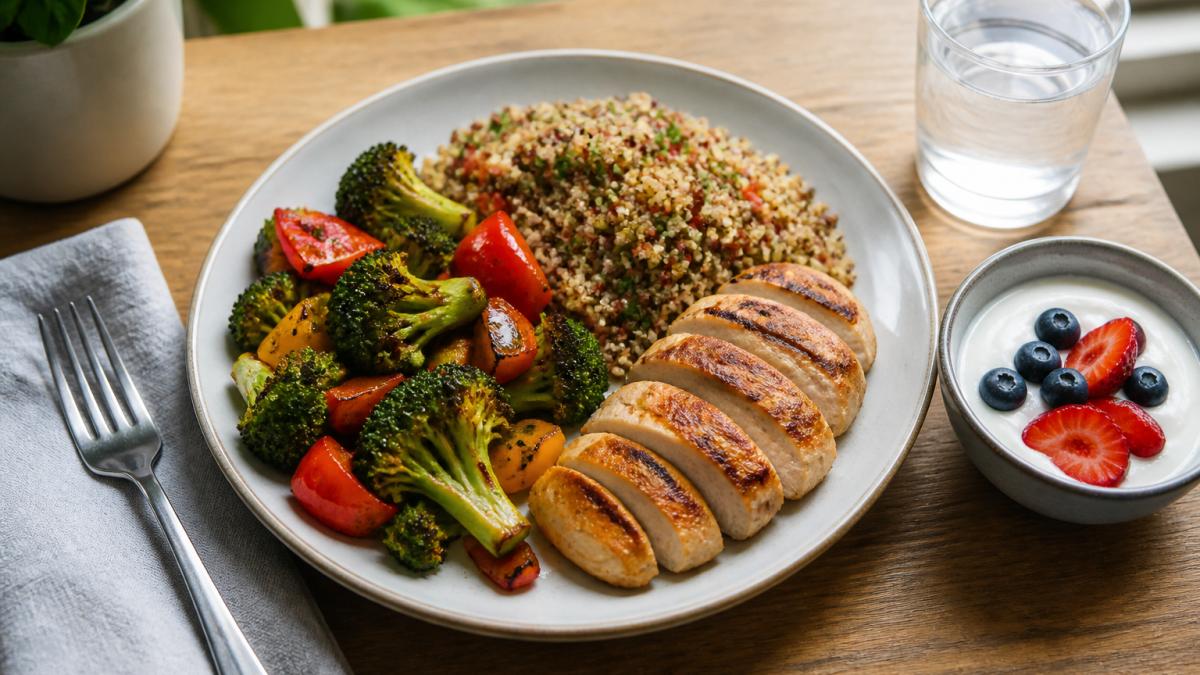
How to Get 100 Grams of Protein a Day as a Woman
Protein sources vary in quality and leucine content. Animal proteins, chicken, beef, fish, eggs, Greek yogurt, cottage cheese, contain all essential amino acids and higher leucine levels.
A practical daily structure looks like this:
- Breakfast (30g): 2 eggs, 1 cup Greek yogurt, or 1.5 cups cottage cheese with fruit
- Mid-morning snack (10g): Handful of almonds or string cheese
- Lunch (35g): 5-6 ounces grilled chicken, fish, or lean beef with vegetables and grains
- Afternoon snack (10g): Protein shake, Greek yogurt, or hard-boiled eggs
This delivers roughly 120 grams of protein without feeling restrictive, using familiar foods rather than specialized supplements or meal replacements.
Aged cheese, Greek yogurt, and cottage cheese deserve special mention: 15-25 grams of protein per serving, satisfying, and no cooking required, ideal for busy professionals needing quick protein.
High-Protein Menopause Meal Plan and Ideas
A practical high-protein menopause meal plan emphasizes whole foods that deliver sustained energy and muscle support.
Monday:
- Breakfast: Vegetable omelet (2 eggs) with whole grain toast and berries
- Lunch: Grilled salmon (5 oz) with roasted sweet potato and green beans
- Dinner: Lean ground turkey (5 oz) tacos with Greek yogurt instead of sour cream
- Snacks: Greek yogurt, almonds
Tuesday:
- Breakfast: Cottage cheese bowl with granola and peaches
- Lunch: Rotisserie chicken (5 oz) with quinoa and roasted vegetables
- Dinner: Baked cod (5 oz) with brown rice and broccoli
- Snacks: String cheese, protein smoothie
Wednesday:
- Breakfast: Greek yogurt parfait with nuts and berries
- Lunch: Lentil soup with grilled chicken breast (4 oz)
- Dinner: Beef stir-fry (5 oz) with brown rice and mixed vegetables
- Snacks: Hard-boiled eggs, almonds
Thursday:
- Breakfast: Scrambled eggs (3) with avocado and whole grain toast
- Lunch: Turkey and vegetable wrap with hummus
- Dinner: Baked tilapia (5 oz) with sweet potato and asparagus
- Snacks: Greek yogurt, cheese
Friday:
- Breakfast: Oatmeal with protein powder and berries
- Lunch: Grilled chicken (5 oz) with wild rice and roasted Brussels sprouts
- Dinner: Lean beef burger (5 oz) on whole wheat with salad
- Snacks: String cheese, nuts
Weekend flexibility: Adjust portions based on activity level. Training days can shift toward the higher protein end; rest days can be slightly lower while maintaining the 100-gram target.
Plant-based protein requires intentional combination. A meal with beans, lentils, or tofu should include a whole grain (rice, quinoa, whole wheat) to create a complete amino acid profile.
Protein and Strength Training During Menopause
Protein alone doesn’t preserve muscle during menopause, resistance training provides the stimulus that tells your body to keep muscle tissue.
Protein provides the building blocks; strength training sends the signal to use them.
A practical strength program for menopause focuses on progressive overload, gradually increasing weight, reps, or sets.
Training 2-3 times per week with resistance is sufficient for muscle retention.
Consuming protein within a few hours after strength training optimizes muscle protein synthesis.
Measuring Progress and Adjusting Your Approach
“You’ll feel better” is not a measurement. To know whether your protein and training strategy is preserving muscle, track metrics that separate muscle from fat and real change from daily fluctuation.
Strength is your best proxy for muscle
Retained muscle gets stronger or holds steady; lost muscle gets weaker. Track a small set of lifts you can repeat under the same conditions:
- A lower-body push: goblet squat or leg press
- A lower-body hinge: Romanian deadlift or hip thrust
- An upper-body push: dumbbell bench press or overhead press
- An upper-body pull: seated row or lat pulldown
Log weight and reps, then retest every 4-6 weeks. Holding the same weight and reps while losing fat means you kept muscle; adding weight or reps is a stronger win. Losing strength across two consecutive retests signals you to eat more protein, add a training day, or check recovery and sleep.
Body composition, not body weight
The scale can’t tell muscle from fat, water, or glycogen. Use one of these instead, sticking with the same method every time:
- Tape measure: waist at the navel, hips at the widest point, thigh at mid-thigh, upper arm at mid-bicep. Measure first thing in the morning, before eating, once every 2 weeks. A shrinking waist with a stable arm and thigh is the pattern you want.
- Progress photos: same spot, same lighting, same time of day, same clothing, every 4 weeks. Side-by-side comparisons reveal changes the scale hides.
- DEXA scan: the most accurate widely available option for tracking lean mass and fat mass separately. Many clinics offer them for a modest fee. Two scans 3-6 months apart tell you far more than a year of daily weigh-ins.
- Bioelectrical impedance scales: convenient but sensitive to hydration. Use them only for trend direction, never for a single reading.
Realistic timelines
- Weeks 1-4: strength may improve quickly as your nervous system adapts. This is not yet muscle growth, it is your body learning to recruit muscle more efficiently.
- Weeks 4-12: measurable strength gains and early body-composition shifts. This is when tape measurements and photos start to show change.
- Months 3-6: visible muscle retention or modest gain, especially if you are new to resistance training. DEXA changes become meaningful.
- Beyond 6 months: the goal shifts from building to defending. Holding lean mass through menopause is the win, not adding pounds of muscle.
When to adjust
- Strength plateau for 3+ weeks: add 10-15 g of daily protein, add one training day, or increase your training load.
- Losing strength while in a calorie deficit: your deficit is too aggressive. Raise calories slightly or raise protein toward the top of your range.
- Digestive discomfort from high protein: spread intake across more meals, favor fish, eggs, dairy, and whey over large red-meat servings, and increase fiber and water.
- Waist shrinking but strength dropping: you are losing muscle along with fat. Increase protein and reduce the size of your calorie deficit.
If you have kidney disease, are on a protein-restricted diet for any medical reason, or take medications that affect protein metabolism, do not adjust your intake without guidance from your physician or a registered dietitian.
Working with a healthcare provider ensures your approach aligns with your individual health status. Certain medications, kidney function, or other health conditions may influence optimal protein intake. Our doctor-supervised approach integrates nutrition guidance with hormone balancing and strength training support, so your protein strategy is measured against real outcomes, not guesswork.
Frequently Asked Questions
Can you still build muscle during menopause?
Yes. Although estrogen decline reduces muscle protein synthesis, a high-protein diet combined with resistance training preserves and builds muscle mass during menopause. Studies show women who maintain adequate protein intake (1.2-1.6 grams per kilogram of body weight daily) and perform strength training 2-3 times weekly can maintain or increase lean muscle mass even after menopause. Consistency matters more than age.
How much protein should you eat during menopause to maintain muscle?
Aim for 1.2-1.6 grams of protein per kilogram of ideal body weight daily. For a 150-pound woman, this equals approximately 82-109 grams per day. Distribute protein across 3-4 meals, with 25-40 grams per meal to maximize muscle protein synthesis. Individual needs vary based on activity level, age, and medical history; a qualified healthcare provider can personalize your target.
What are easy high-protein meals for menopause?
Greek yogurt with berries and almonds (20g protein), grilled salmon with sweet potato and broccoli (35g), cottage cheese with fruit (25g), and turkey or chicken with quinoa and vegetables (30g) are practical options. Eggs, legumes, lean beef, and plant-based options like tofu and tempeh also work well. Aim for whole foods that keep you full and support stable energy throughout the day.
Does protein alone prevent muscle loss during menopause?
Protein is essential but not sufficient on its own. Resistance training is required to stimulate muscle protein synthesis and counteract the effects of declining estrogen. Combine a high-protein diet with progressive strength training 2-3 times weekly, adequate sleep, and stress management for best results. Bioidentical hormone replacement therapy may also support muscle preservation when medically appropriate.
How should you combine protein and strength training during menopause?
Consume 20-40 grams of protein within 1-2 hours after resistance training to support muscle repair and growth. Perform compound movements like squats, deadlifts, and chest presses 2-3 times weekly, allowing 48 hours between sessions for recovery. Gradually increase weight or repetitions over time. Pair consistent training with adequate daily protein intake and recovery strategies like sleep and stress reduction.
Should I eat more protein during menopause?
Yes. Protein needs increase during menopause due to declining estrogen and accelerated muscle loss. Most women benefit from 1.2-1.6 grams per kilogram of body weight daily, compared to 0.8 grams per kilogram for general health. Higher protein intake also supports satiety, helps manage weight gain common during menopause, and preserves bone strength alongside resistance training.