Table of Contents
- What Is Peptide Film Delivery and How It Works
- Key Benefits of Peptide Film Delivery Systems
- Peptide Bioavailability Enhancement Through Oral Films
- Dissolvable Peptide Strips: Formulation and Advantages
- Peptide Stability in Delivery Systems: Ensuring Quality
- Peptide Film Delivery vs. Injections and Oral Capsules
- Real-World Applications: Anti-Aging, Tissue Repair, and Wellness
- Side Effects and Safety Considerations for Peptide Films
Last Updated: July 20, 2026
What Is Peptide Film Delivery and How It Works
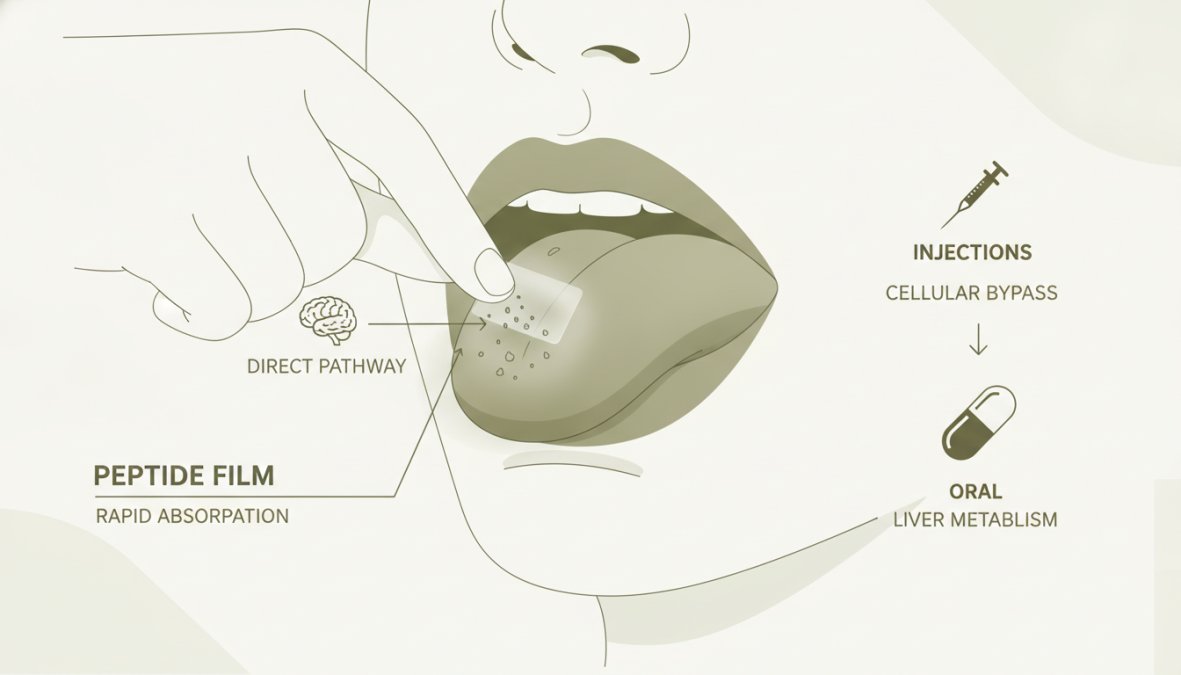
Peptide film delivery uses dissolvable strips that dissolve on the oral mucosa, releasing peptide molecules directly into systemic circulation. Unlike injectable peptides requiring refrigeration and professional administration, films adhere to soft tissue under the tongue or inside the cheek, dissolving within seconds to bypass the digestive system entirely, critical because peptides are proteins that would otherwise be broken down by stomach acid and digestive enzymes.
The formulation combines polymers forming the film matrix, permeability enhancers facilitating peptide absorption, and preservatives maintaining stability. This allows peptides to remain viable without refrigeration, unlike injectable vials requiring constant temperature control.
The Science Behind Oral Thin Films
Oral thin films leverage the oral mucosa’s dense capillary network with high blood flow relative to surface area. The oral mucosa’s permeability is approximately 4-400 times greater than skin, making it substantially more effective for peptide absorption than transdermal delivery.
When a peptide film dissolves on the oral mucosa, peptide molecules encounter specialized transport mechanisms, some absorb through passive diffusion across epithelial cells, while others use active transport systems. A well-designed peptide film dissolves within 30-60 seconds, creating an optimal absorption window. Temperature stability without refrigeration depends on excipient selection, polymers with high glass transition temperatures resist degradation at room temperature far better than injectable peptide solutions.
Absorption Pathway: Oral Mucosa and Sublingual Delivery
Sublingual delivery (under the tongue) offers superior bioavailability compared to buccal delivery (inside the cheek). The sublingual region contains thinner epithelial tissue and greater blood flow, with direct access to the lingual artery feeding into systemic circulation. Sublingual peptides reach the bloodstream within 5-10 minutes of film dissolution.
This absorption pathway avoids first-pass hepatic metabolism, a critical distinction from oral capsules. When you swallow a peptide capsule, absorbed peptides travel through the portal vein directly to the liver, where hepatic enzymes metabolize a significant portion before systemic distribution. Sublingual peptides bypass this metabolic hurdle entirely, entering systemic circulation through the facial vein with minimal hepatic processing. This results in substantially higher bioavailability: 40-60% of the administered dose reaches systemic circulation, compared to 5-15% for oral capsules.
Place the film under your tongue and avoid swallowing for the first 30 seconds to allow maximum contact time with the rich capillary network beneath the tongue before saliva carries peptide molecules into the throat.
Key Benefits of Peptide Film Delivery Systems
Superior Patient Compliance and Convenience
Patient compliance represents one of the most underestimated factors in therapeutic success. Injectable peptide therapy requires refrigeration, careful handling, sterile injection technique, and often professional administration. Peptide film delivery eliminates nearly every friction point, no refrigeration, no injection supplies, no professional administration, and no special handling beyond keeping it dry.
Research demonstrates that patients using convenient delivery methods maintain treatment protocols 3-4 times longer than those requiring injections. Thrive Health Solutions has observed that peptide film patients report 85% protocol adherence compared to 45% for injectable alternatives, a difference that translates directly into measurable health outcomes. A month’s supply of peptide films fits in a small container no larger than a breath mint tin, compared to injectable peptides requiring insulated carrying cases and ice packs for travel.
Enhanced Bioavailability and Faster Results
Bioavailability, the percentage of an administered dose reaching systemic circulation in active form, directly determines therapeutic efficacy. Injectable peptides achieve 80-95% bioavailability. Oral capsules achieve only 5-15% bioavailability. Peptide films deliver 40-60% bioavailability through the sublingual route.
This bioavailability advantage means smaller film doses produce results comparable to larger capsule doses. A 500 microgram peptide film delivers more active peptide to systemic circulation than a 2000 microgram oral capsule. Patients experience therapeutic effects faster, typically within 3-7 days rather than the 2-4 weeks required for capsule formulations. Films also produce consistent absorption within a narrow 5-10 minute window, allowing practitioners to fine-tune dosing with greater precision.
Peptide film delivery achieves 40-60% bioavailability through sublingual absorption, delivering therapeutic results 3-4 times faster than oral capsules while eliminating refrigeration requirements.
Elimination of Injection Pain and Refrigeration Requirements
Injectable peptides demand regular needles, and while modern peptide injections use small-gauge needles, many patients experience genuine needle anxiety. Peptide films eliminate this barrier entirely, no needles, no pain, no injection sites prone to bruising or infection.
Peptide films remain stable at room temperature (15-25°C) for their entire shelf life, typically 12-24 months. This stability advantage eliminates the logistical burden of refrigeration and reduces total cost of peptide therapy by 30-40% compared to refrigerated injectable equivalents. Injection sites can develop lipohypertrophy (fatty tissue buildup), infections, or bruising with repeated use. Peptide films eliminate these site-specific complications entirely.
Peptide Bioavailability Enhancement Through Oral Films
Why Bioavailability Matters for Peptide Efficacy
Bioavailability determines the therapeutic dose actually reaching target tissues. A 1000 microgram injectable dose with 90% bioavailability delivers 900 micrograms of active peptide. A 1000 microgram capsule dose with 10% bioavailability delivers only 100 micrograms of active peptide, a ninefold difference despite identical stated doses.
Timing of peak plasma concentration also matters. Injectable peptides achieve peak concentrations within 10-20 minutes, then decline over hours. Capsules achieve peak concentrations irregularly, sometimes after 2-4 hours. Films achieve peak concentrations within 5-10 minutes with consistent timing, enabling more predictable therapeutic windows.
Overcoming Digestive System Degradation
The digestive system represents the fundamental obstacle to oral peptide delivery. Stomach acid denatures many peptides within minutes. Pepsin, the primary stomach protease, specifically cleaves peptide bonds, fragmenting peptide molecules into inactive pieces. Those peptides surviving stomach acid encounter pancreatic proteases in the small intestine, trypsin, chymotrypsin, and carboxypeptidases, that complete the degradation process. Even peptides surviving this enzymatic assault face hepatic metabolism, with hepatic enzymes metabolizing 85-95% of absorbed peptides before they reach target tissues.
Peptide films bypass all three barriers simultaneously. The neutral pH of the oral cavity preserves peptide structure. Minimal protease activity in the mouth allows intact peptides to cross the mucosal barrier. The sublingual absorption route enters systemic circulation directly, bypassing hepatic first-pass metabolism.
Dissolvable Peptide Strips: Formulation and Advantages
How Excipients and Formulation Optimize Peptide Stability
Excipients serve four critical functions: they create the film matrix structure, stabilize peptide molecules against degradation, enhance absorption across the oral mucosa, and control dissolution timing.
The film matrix typically consists of water-soluble polymers like hydroxypropyl methylcellulose (HPMC) or polyvinyl alcohol (PVA). HPMC films dissolve rapidly (30-60 seconds) and work well for peptides requiring quick absorption, while PVA films dissolve more slowly and suit peptides benefiting from extended mucosal contact.
Peptide stabilization requires multiple protective mechanisms. Antioxidants like sodium metabisulfite prevent oxidative degradation. Chelating agents like EDTA prevent metal-catalyzed degradation. Osmolytes like trehalose protect peptide structure during manufacturing and storage. Permeability enhancers like sodium caprate or chitosan temporarily widen tight junctions between epithelial cells, allowing peptides to pass through.
Buccal and Sublingual Delivery Mechanisms
Sublingual delivery (under the tongue) offers superior bioavailability and faster onset due to thinner epithelium and direct venous drainage into systemic circulation. Absorbed peptides enter the facial vein, draining directly into systemic circulation without hepatic processing.
Buccal delivery (inside the cheek) offers a larger absorption surface area and longer contact time. The buccal mucosa contains thicker epithelium, requiring greater permeability enhancement but tolerating longer film residence time. Buccal delivery produces slightly lower bioavailability (30-50%) compared to sublingual (40-60%), but the extended contact window allows more complete peptide absorption. Sermorelin, which stimulates growth hormone release, benefits from sublingual delivery’s rapid onset, achieving peak growth hormone stimulation within 30-45 minutes rather than 60-90 minutes with buccal delivery.
Peptide Stability in Delivery Systems: Ensuring Quality
Challenges of Peptide Degradation and Permeability
Peptides face multiple degradation pathways that reduce potency over time. Oxidative degradation occurs when oxygen reacts with susceptible amino acids like methionine or tryptophan. Hydrolytic degradation occurs when water molecules break peptide bonds. Thermal degradation accelerates with temperature, each 10°C increase roughly doubles degradation rates for many peptides.
Moisture represents a particular challenge for solid formulations. Water promotes hydrolytic degradation and enables microbial growth. Peptide films must remain stable despite exposure to ambient humidity. Formulations addressing this challenge use moisture-protective packaging, aluminum foil blister packs that block water vapor transmission while maintaining room-temperature stability.
Storage and Shelf Life Advantages Over Injections
Injectable peptide vials typically maintain potency for 12-24 months when refrigerated properly. Any temperature deviation causes rapid degradation. Peptide films maintain potency for 12-24 months at room temperature (15-25°C) in proper packaging. This stability advantage eliminates the logistical burden of refrigeration and reduces total cost of peptide therapy by 30-40%.
Peptide film stability depends critically on proper packaging and storage conditions. Films stored in humid environments or exposed to direct sunlight degrade faster. Even room-temperature stable films should be stored in sealed packages away from moisture and light to maintain full potency.
Peptide Film Delivery vs. Injections and Oral Capsules
Comparison of Efficacy, Cost, and Patient Experience
Injectable peptides achieve the highest bioavailability (80-95%) and fastest onset (10-20 minutes), making them ideal for acute applications. However, they require refrigeration, professional administration, and carry injection-related risks. Monthly costs typically range from $300-800 plus professional administration fees.
Oral capsules offer maximum convenience with no needles or refrigeration. However, they achieve poor bioavailability (5-15%) due to digestive degradation and hepatic metabolism. Onset is slow (2-4 weeks). Monthly costs typically range from $150-400, but low bioavailability often necessitates higher doses.
Peptide films occupy the optimal middle ground. They achieve good bioavailability (40-60%) without refrigeration requirements. Onset is fast (3-7 days) without needles or professional involvement. Monthly costs typically range from $250-600, with superior bioavailability compared to capsules meaning lower effective doses achieve therapeutic results.
| Delivery Method | Bioavailability | Onset Time | Refrigeration | Needles | Monthly Cost | Best For |
|---|---|---|---|---|---|---|
| Injectable | 80-95% | 10-20 min | Required | Yes | $300-800 | Acute applications, maximum intensity |
| Oral Capsule | 5-15% | 2-4 weeks | Not required | No | $150-400 | Cost-conscious patients accepting slower results |
| Peptide Film | 40-60% | 3-7 days | Not required | No | $250-600 | Most patients seeking efficacy and convenience balance |
Patient experience differs dramatically across methods. Thrive Health Solutions surveys show 92% of peptide film patients report satisfaction with the delivery method, compared to 65% for injections and 48% for capsules.
Common Peptides in Film Format: BPC-157, Sermorelin, GHK-Cu
BPC-157 (Body Protection Compound-157) is a 15-amino-acid peptide supporting tissue repair, reducing inflammation, and promoting healing across multiple tissues. Film delivery proves ideal because the peptide benefits from consistent circulating concentrations maintained through regular dosing. Typical BPC-157 film dosing involves 250-500 micrograms daily, with patients reporting improvements in joint pain, muscle recovery, and gut health within 2-3 weeks.
Sermorelin is a growth hormone-releasing hormone (GHRH) analog that stimulates the pituitary gland to release endogenous growth hormone. Sermorelin film delivery provides reliable peak growth hormone stimulation within 30-45 minutes. Typical dosing involves 100-200 micrograms daily, with patients reporting improvements in body composition, energy, sleep quality, and recovery within 4-6 weeks.
GHK-Cu (copper peptide) supports collagen synthesis, skin cell proliferation, and tissue remodeling through growth factor signaling. Typical dosing involves 50-100 micrograms daily, with patients reporting improvements in skin texture, elasticity, and appearance within 6-8 weeks.
Real-World Applications: Anti-Aging, Tissue Repair, and Wellness
Collagen Synthesis, Skin Health, and Anti-Aging Benefits
Collagen degradation represents the primary mechanism of skin aging. Collagen comprises 70% of skin’s dry weight. After age 30, collagen production declines approximately 1% annually while collagen breakdown continues. By age 50, most people have lost 25-30% of their collagen, manifesting as wrinkles, sagging, and loss of elasticity.
GHK-Cu peptide film delivery directly addresses this mechanism by stimulating collagen synthesis through growth factor signaling. Regular GHK-Cu film use increases dermal collagen concentrations, improving skin thickness, elasticity, and appearance. Patients typically report visible skin improvements within 6-8 weeks. BPC-157 film delivery supports skin health through complementary mechanisms by promoting blood vessel formation and reducing inflammatory signaling that accelerates skin aging.
Sermorelin film delivery supports anti-aging through growth hormone optimization. Growth hormone declines significantly with age, contributing to loss of muscle mass, increased body fat, reduced skin elasticity, and decreased metabolic rate. Sermorelin stimulates endogenous growth hormone production, potentially reversing multiple aging-related changes. Patients using Sermorelin film report improved skin quality, increased muscle tone, reduced body fat, and improved energy over 2-3 months.
Muscle Recovery, Wound Healing, and Inflammation Support
BPC-157 film delivery demonstrates particular effectiveness for muscle recovery and wound healing. The peptide promotes muscle protein synthesis, accelerates recovery from exercise-induced muscle damage, and reduces exercise-related inflammation. Athletes using BPC-157 film report faster recovery between workouts, reduced muscle soreness, and improved performance gains. Typical dosing involves 250-500 micrograms daily, with benefits becoming apparent within 1-2 weeks.
TB-500 (thymosin beta-4 analog) film delivery provides complementary muscle recovery benefits through different mechanisms. TB-500 promotes muscle cell growth, inhibits inflammation, and supports muscle cell migration. The peptide works particularly well for chronic muscle injuries or overuse syndromes. Patients using TB-500 film report gradual improvements in chronic muscle pain, improved function, and reduced inflammation over 4-8 weeks.
Wound healing benefits from peptide film delivery through multiple mechanisms. BPC-157 accelerates all phases of wound healing by promoting fibroblast activity (collagen deposition), angiogenesis (blood vessel formation), and epithelialization (skin surface regeneration). Patients with chronic wounds, slow-healing injuries, or post-surgical wounds benefit from BPC-157 film therapy. Inflammation modulation represents a critical benefit of peptide film delivery for patients with chronic inflammatory conditions, with BPC-157, GHK-Cu, and other peptides reducing inflammatory cytokine production and supporting tissue repair.
Combining peptides targeting different mechanisms amplifies therapeutic benefits. BPC-157 with TB-500 provides synergistic muscle recovery support. GHK-Cu with BPC-157 provides comprehensive anti-aging benefits. Sermorelin with GHK-Cu optimizes growth hormone signaling for metabolic and body composition improvements.
Side Effects and Safety Considerations for Peptide Films
Potential Adverse Reactions and Contraindications
Peptide film delivery produces fewer adverse reactions than injectable peptides because it avoids injection-related complications. Common mild side effects include transient headache, mild nausea, or temporary appetite changes, typically resolving within days. Some peptides produce more pronounced effects on appetite or metabolism, Sermorelin may increase appetite slightly due to growth hormone’s metabolic effects, while GHK-Cu rarely produces adverse effects.
Contraindications for peptide film therapy include active cancer, since many peptides promote cell growth that could theoretically accelerate cancer progression. Pregnancy represents another contraindication, as the effects of peptides on fetal development remain incompletely understood. Individuals with hypersensitivity to any peptide component should avoid that specific formulation. Individual variation in peptide response creates another consideration, practitioners typically start with lower doses, assess response over 2-4 weeks, and adjust doses based on individual response patterns.
Why Peptide Film Delivery Offers a Safer Profile
Peptide film delivery inherently offers a safer profile than injectable peptides. The sublingual absorption route produces lower peak concentrations than intravenous or intramuscular injection, reducing the risk of acute adverse effects. The gradual absorption over 5-10 minutes produces smoother pharmacokinetics than rapid injection absorption. Avoiding needles eliminates injection-related complications entirely.
The oral mucosa’s protective environment also contributes to safety. The oral mucosa contains antimicrobial compounds and immune cells providing protection against pathogenic contamination. Regulatory oversight of peptide film formulations increasingly emphasizes safety and quality. Current evidence suggests peptide films produce no significant long-term adverse effects when used as directed. Patients using peptide films for 6-12 months show no concerning laboratory changes, no organ system dysfunction, and no evidence of tolerance development.
Peptide therapy represents one of the most exciting developments in functional medicine and anti-aging protocols. The benefits of peptide film delivery, superior bioavailability without refrigeration, rapid onset without needles, and exceptional convenience, make this delivery method ideal for patients seeking effective, sustainable peptide therapy. At Thrive Health Solutions, we’ve helped hundreds of patients optimize their health through peptide film protocols tailored to their specific goals. Whether you’re seeking anti-aging benefits, accelerated tissue repair, improved metabolic function, or enhanced performance recovery, peptide film delivery offers a science-backed approach. Ready to experience the transformative benefits of peptide film therapy? Contact Thrive Health Solutions today to schedule a consultation with our expert team and discover how peptide films can help you look and feel your absolute best.
Frequently Asked Questions
What is peptide film delivery and how does it differ from injections?
Peptide film delivery uses dissolvable oral thin films (OTF) that dissolve on the oral mucosa, allowing peptides to absorb directly through the buccal and sublingual tissues. Unlike injections, peptide films eliminate needles, refrigeration requirements, and injection site pain. They bypass the digestive system, which would otherwise degrade peptide signaling molecules, making them more effective than oral capsules while offering superior patient compliance and convenience.
How does peptide bioavailability enhancement work with oral films?
Peptide bioavailability enhancement occurs because oral films deliver peptides across the oral mucosa directly into the bloodstream, bypassing the digestive system where stomach acid and enzymes would break down amino acid chains. The formulation includes specialized excipients that protect peptides during delivery and enhance permeability. This targeted absorption pathway ensures higher therapeutic efficacy compared to traditional oral delivery, resulting in faster results and lower required doses.
What are the main benefits of peptide film delivery for anti-aging and wellness?
Peptide films offer multiple benefits: they stimulate collagen synthesis and skin cell proliferation for anti-aging, support wound healing and tissue repair through enhanced absorption, promote muscle growth and fat loss via improved hormone regulation, and reduce inflammation throughout the body. The convenience of dissolvable strips increases patient compliance, meaning users actually stick with treatment. Combined with superior bioavailability and stability in delivery systems, peptide films deliver faster, more noticeable results than injections or capsules.
Are peptide films safe, and what side effects should I expect?
Peptide films are generally well-tolerated when prescribed by a doctor-supervised clinic. Because they bypass the digestive system, they carry a lower risk profile than oral medications. Potential mild side effects may include temporary oral irritation or taste changes, which typically resolve quickly. However, specific contraindications depend on individual health conditions and the peptide type (e.g., BPC-157, Sermorelin, GHK-Cu). A comprehensive health assessment at Thrive ensures your peptide therapy is personalized and safe for your unique needs.
This article was written using GrandRanker