Table of Contents
- Why Low Impact Cardio Works for Midlife Weight Loss
- Best Cardio for Women Over 40: 7 Joint-Friendly Workouts
- How to Lose Weight During Perimenopause: A Practical Approach
- Low Impact Cardio Routine for Beginners: A 4-Week Plan
- Pelvic Floor and Recovery: What Most Cardio Guides Skip
- Equipment-Free Home Modifications for Low Impact Cardio
- Conclusion: Your Next Steps for Midlife Weight Loss
- Frequently Asked Questions
Last Updated: September 30, 2026
Why Low Impact Cardio Works for Midlife Weight Loss
Low impact cardio workouts for midlife weight loss raise daily energy expenditure without the joint stress and recovery cost of high-impact exercise. This guide from Thrive Health Solutions covers seven joint-friendly workouts, a four-week beginner plan, and the hormonal factors most cardio guides ignore.
Best Cardio for Women Over 40: 7 Joint-Friendly Workouts
The best cardio for women over 40 is whatever you will repeat three to four times per week without joint pain or burnout. Low impact does not mean low effort: one foot stays grounded or the machine absorbs the load, so knees, hips, and ankles recover faster.
| Workout | Joint Impact | Equipment Needed | Best For |
|---|---|---|---|
| Incline walking | Low | Treadmill or hill | Beginners, daily habit |
| Swimming | None | Pool access | Sore joints, full body |
| Cycling | Low | Bike or stationary | Knee-friendly cardio |
| Rowing | Low | Rowing machine | Full-body effort |
| Elliptical | Low | Elliptical machine | Running-style motion |
| Stair climbing | Moderate | Stairs or stepper | Short, intense sessions |
| Strength circuits | Low | Bands or dumbbells | Metabolic rate support |
1. Incline Walking
Incline walking raises your heart rate and calorie burn without the pounding of running. A 10 to 15 percent incline turns a flat walk into genuine cardio in 30 minutes; start at 3 percent and add a percent weekly. It is the easiest habit to build because you can do it on a treadmill or any hill.
2. Swimming and Water Aerobics
Swimming removes almost all joint impact because the water supports your body weight, and it builds aerobic capacity while working the upper body. Water aerobics suits anyone with arthritis or injury history. Aim for 30 to 45 minutes, two to three times weekly.
3. Cycling (Outdoor or Stationary)
Cycling is weight-bearing only through the seat, so knees and hips stay protected. Stationary bikes let you control resistance and cadence precisely, making intervals easier to program; outdoor cycling adds variety but weather and traffic become excuses.
4. Rowing
Rowing engages roughly 85 percent of your muscles in one movement, combining upper and lower body work with a smooth, low-impact pull. The learning curve is real: poor form stresses the lower back, so spend your first two sessions on technique with light resistance.
5. Elliptical Training
The elliptical mimics a running stride while your feet never leave the pedals, so ground impact disappears. It suits anyone who misses running but cannot tolerate the pounding; add resistance and incline to push intensity without joint stress.
6. Stair Climbing
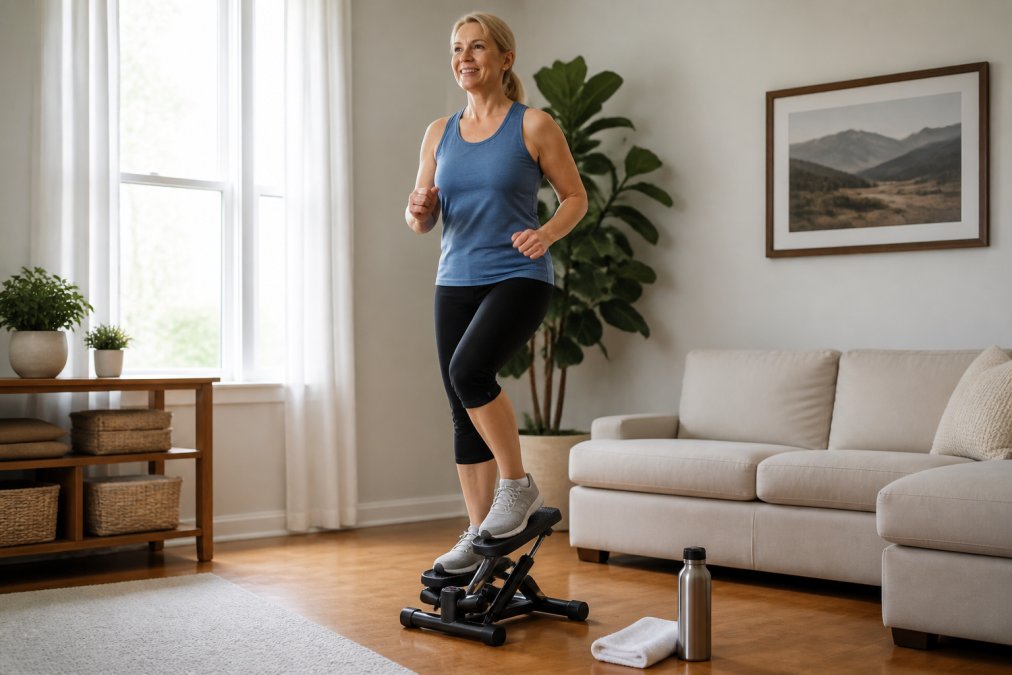
Stair climbing is the highest-intensity option here. A few minutes raises your heart rate fast, making it efficient for short sessions. Use a mini-stepper or real stairs, but build gradually because knees and calves take on more load than flat walking.
7. Low-Impact Strength and Cardio Circuits
Circuits pair light resistance with short cardio bursts: alternate 40 seconds of band rows or dumbbell presses with 40 seconds of marching or stepping. This raises your metabolic rate and preserves lean muscle mass, which matters more with every passing decade.
The thing nobody tells you about incline walking: holding the handrails cuts your calorie burn substantially because it unloads your body weight. Let your arms swing naturally, even if you drop the incline a point or two to manage it.
How to Lose Weight During Perimenopause: A Practical Approach
Learning how to lose weight during perimenopause starts with accepting that the old rules have changed. Calorie deficits still matter, but hormonal fluctuations shift where fat is stored, how muscle is preserved, and how well you recover. The plan that worked at 35 often stalls at 48.
Strength Training vs. Cardio for Weight Loss
Strength training and cardio do different jobs, and midlife weight management needs both. Cardio burns calories during the session. Strength training builds and preserves lean muscle mass, which supports a higher resting metabolic rate around the clock.
The Role of NEAT and TDEE in Midlife Weight Management
NEAT (Non-Exercise Activity Thermogenesis) is the energy you burn through daily movement that is not formal exercise: walking to the car, gardening, taking stairs, standing while on calls. TDEE (Total Daily Energy Expenditure) is everything you burn in a day: resting metabolic rate, digestion, deliberate exercise, and NEAT.
For midlife weight loss, daily movement (NEAT) frequently outweighs the calorie burn of a single workout. Build movement into your day first, then add structured cardio on top.
Low Impact Cardio Routine for Beginners: A 4-Week Plan
A low impact cardio routine for beginners should start below your capacity and build steadily. This four-week plan assumes three cardio sessions per week plus daily walking, and works for most fitness levels. Adjust the minutes based on how you feel.
Week 1-2: Building Your Base
Weeks one and two establish the habit and let your joints and cardiovascular system adapt. Keep intensity moderate, meaning you can hold a conversation while working. If you are brand new to exercise or returning after a long break, repeat weeks one and two before moving on. (Source: the National Institutes of Health (NIH) notes that hormonal shifts during menopause can impact metabolism and body composition)
- Session 1: 20 minutes incline walking at 3 percent, RPE 4 to 5
- Session 2: 20 minutes stationary cycling at easy resistance, RPE 4 to 5
- Session 3: 20 minutes swimming or water aerobics, RPE 4 to 5
- Daily: 10-minute walk after meals
Week 3-4: Adding Intensity and Duration
Weeks three and four add time first, then intensity. Add five minutes to each session, then introduce short intervals: one minute harder, two minutes easy, repeated five times. This is interval training in its gentlest form, improving aerobic capacity without hammering your joints.
- Session 1: 25 minutes incline walking with five 1-minute pickups at RPE 7
- Session 2: 25 minutes cycling with five 1-minute faster efforts at RPE 7
- Session 3: 25 minutes rowing or elliptical, steady at RPE 5
- Daily: 15-minute walk after meals
How to Progress After Week 4
Once you finish four weeks, do not simply add more hard sessions. Add one session per week before adding intensity, then extend the longest session by five minutes every two weeks. A common pattern is four cardio days and one longer weekend session of 40 to 45 minutes before touching interval volume again.
When to Back Off
Track how you feel each week. If joint pain appears, drop back a level rather than pushing through. If pain lasts more than 48 hours after a session, cut that session’s duration or intensity by about a third for the next week. If you sleep poorly or your resting heart rate is noticeably higher than usual in the morning, treat that day as active recovery instead of a hard session.
Schedule your hardest session for the day after your best night of sleep, not the day after your worst. Recovery capacity, not motivation, is what limits midlife progress.
Pelvic Floor and Recovery: What Most Cardio Guides Skip
Pelvic floor considerations are the piece most cardio guides skip, and they matter through perimenopause and post-menopause. Estrogen decline affects pelvic floor tissue, and high-impact exercise can worsen leaking or heaviness in some women. Low impact cardio is often the safer starting point, but “low impact” is not automatically “pelvic floor safe.”
Which Low Impact Exercises Are Usually Safe, and Which Need Caution
The pelvic floor manages two forces: downward pressure from the abdomen and impact transmitted up through the legs. Exercises that keep one foot grounded and avoid heavy bracing tend to be the most forgiving.
- Usually well tolerated: walking, incline walking, stationary cycling, swimming, water aerobics, and gentle rowing with controlled breathing.
- Use caution: stair climbing and mini-steppers, because the repeated single-leg loading and downward pressure can aggravate symptoms. Elliptical work is usually fine, but some women find the standing position and resistance increase pressure.
- Often problematic: running, jumping, plyometrics, and any high-impact or heavy-bracing movement. These are the first to drop if you notice symptoms.
How to Screen Yourself
A simple self-check before and after sessions catches problems early. Notice whether you leak, feel heaviness, or feel a bulge or pressure in the vagina during or after exercise, or whether you have to rush to the bathroom or feel incomplete emptying. Any of these is a signal to see a pelvic floor physical therapist, not to push harder.
Cortisol Management and Active Recovery
Cortisol is the hormone your body releases under stress, and it rises with intense exercise, poor sleep, and chronic stress. In midlife, that response can be exaggerated. Cortisol management means balancing hard sessions with genuine recovery.
A common mistake is stacking intense cardio on top of poor sleep and high life stress. That combination raises cortisol and can stall fat loss even when you are eating well. If results stall, check your recovery before adding more workouts.
Low impact does not automatically mean pelvic floor safe. Screen for leaking, heaviness, and pressure, exhale on effort instead of holding your breath, and treat two hard sessions per week as the ceiling, not the floor.
Equipment-Free Home Modifications for Low Impact Cardio
Equipment-free home modifications let you build a real cardio habit without a gym membership or a machine. The two most effective tools are a staircase and a timer.
- Incline walking: Walk stairs or march in place with high knees at a moderate pace
- Stair climbing: Use a single flight, up and down, for timed intervals
- Cycling substitute: Sit-to-stand repetitions from a chair at a steady pace
- Rowing substitute: Standing band rows if you have a band, or bodyweight rows against a table
- Circuit work: Alternate marching, chair squats, wall push-ups, and standing marches
Conclusion: Your Next Steps for Midlife Weight Loss
Midlife weight loss is not about doing more. It is about doing the right things consistently while protecting your joints, recovery, and muscle mass. Low impact cardio gives you a sustainable path that fits a busy schedule and respects what your body needs now.
Frequently Asked Questions
What is the best low impact cardio to lose weight?
There is no single best option, but incline walking, swimming, cycling, rowing, and elliptical training all provide effective low impact cardio. The best choice is the one you will do consistently. Aim for at least 150 minutes of moderate-intensity activity per week, and combine it with strength training twice weekly to preserve lean muscle mass and support your metabolic rate.
How does midlife hormonal change affect fat loss and exercise?
During perimenopause and post-menopause, declining estrogen and progesterone can shift where your body stores fat, slow your metabolic rate, and affect recovery time. Cortisol sensitivity may also increase, meaning high-intensity sessions can leave you more depleted. Low impact cardio and moderate-intensity exercise help you stay active without adding excessive stress on your joints or your endocrine system.
How many minutes of low impact cardio are recommended for weight loss?
Federal physical activity guidelines recommend at least 150 minutes of moderate-intensity aerobic activity per week for general health, and up to 300 minutes for more significant weight management goals. Break this into 30 to 60 minute sessions, five days per week. Adding two strength training sessions and increasing daily NEAT through walking and stair climbing can further support your TDEE and body composition goals.
Can low impact exercise be as effective as HIIT for fat burning?
Both approaches can support fat loss when they create a consistent energy deficit. HIIT burns more calories per minute, but it also demands more recovery time. For many people in midlife, low impact steady-state cardio and moderate-intensity interval training are easier to sustain, produce less cortisol elevation, and are gentler on joints. The most effective routine is the one you can maintain week after week without injury.
What are the best joint-friendly exercises for women over 40?
Swimming, water aerobics, cycling, rowing, elliptical training, and incline walking are all joint-friendly options. These activities provide a cardiorespiratory challenge without the ground impact of running or jumping. Adding resistance bands or adjustable dumbbells for low-impact strength circuits can further boost your metabolic rate and support bone density, which becomes increasingly important after menopause.