Table of Contents
- Why Strength Training Matters for Women Over 50
- How to Start Strength Training at 50
- Essential Equipment for Home Workouts
- Core Compound Movements for Full-Body Strength
- Protein Intake for Muscle Growth After 50
- Creating a Strength Training Workout Plan for Women Over 50
- Low-Impact Modifications and Progressive Overload
- Conclusion
Last Updated: August 22, 2026
Why Strength Training Matters for Women Over 50
Strength training after 50 is essential. Women lose muscle mass at an accelerating rate after menopause, a condition called sarcopenia, that affects metabolism and independence (peer-reviewed research). Strength training exercises for women over 50 directly counteract this decline and deliver benefits far beyond muscle building.
After 50, your body produces less estrogen, affecting bone density, muscle recovery, and metabolic rate. Resistance training becomes your most powerful tool. Consistent strength work builds muscle, protects bones, improves balance, and maintains the functional fitness that keeps you active for decades.
Women over 50 who commit to structured strength training see measurable improvements in muscle mass, bone density, and functional strength within 8-12 weeks (peer-reviewed research). Beyond physical changes, strength training improves mood, reduces anxiety, and supports cognitive sharpness, critical when managing hormonal shifts and energy changes.
Strength training after 50 is about maintaining independence, protecting your bones, and keeping your body capable of the activities you want to do.
How to Start Strength Training at 50
Starting a strength training workout plan for women over 50 requires consistency, proper form, and realistic recovery expectations. Your body needs more recovery time than it did at 30, but this doesn’t prevent progress, it just means you progress differently. Add weight every two weeks instead of weekly, and space muscle groups 48 hours apart.
Begin with two to three sessions per week, focusing on compound movements that work multiple muscle groups. Each session should last 30-45 minutes, including warm-up and cool-down.
The First Four Weeks:
-
Week 1-2: Movement Quality Focus
- Perform bodyweight or light resistance versions of basic movements: goblet squats, wall push-ups, and resistance band rows
- 2 sets of 8-10 reps per exercise, 2 sessions per week
- Goal: establish proper form
-
Week 3-4: Add Resistance Gradually
- Increase weight by 5-10% if the previous week felt easy
- Add a third session with different movement patterns
- Maintain 2-3 sets of 8-12 reps
-
Assess Your Starting Point
- Can you perform 10 bodyweight squats with good form?
- Can you do a wall push-up for 8-10 reps?
- Can you hold a plank for 20-30 seconds?
- If yes to all three, you’re ready for external resistance
Your warm-up matters more now than ever. Spend 5-10 minutes doing dynamic stretching and light movement before lifting. This preps your nervous system and reduces injury risk significantly.
Recovery is where adaptation happens. Sleep, protein intake, and rest days are part of your training plan, not optional extras.
Essential Equipment for Home Workouts
You don’t need a full gym to build serious strength. A few key pieces provide everything necessary for complete strength training exercises for women over 50.
Adjustable Dumbbells like the Bowflex SelectTech 552 replace 15 sets of weights, adjusting from 5 to 52.5 lbs in 2.5 lb increments. Progressive overload, gradually increasing resistance, is how you continue building strength and prevent plateaus.
Resistance Bands provide variable resistance that’s gentler on joints. Bodylastics Resistance Bands Sets include multiple resistance levels, anchors, and handles. Bands are particularly useful for rows and pull-down movements and travel easily.
Suspension Training System like the TRX All-in-One System uses bodyweight and gravity to create resistance. It’s excellent for core stability and functional movement patterns and travels easily.
Stability Ball engages your core during exercises and improves balance. The instability forces stabilizer muscles to activate, especially valuable for maintaining balance and posture.
Foam Roller improves range of motion and reduces soreness, increasingly important after 50 because tissues don’t recover as quickly.
Yoga Mat provides cushioning for floor exercises and protects your joints during push-ups, planks, and stretching.
For guided instruction with real-time feedback, Peloton Guide ($95 hardware + $24/month) offers AI-powered movement tracking and a library of strength classes.
Start with dumbbells and a yoga mat. Add resistance bands once you understand basic movement patterns, then expand based on what exercises you enjoy.
Core Compound Movements for Full-Body Strength
Compound movements work multiple muscle groups simultaneously, making them efficient and functional. These five movements form the foundation of any strength training exercises for women over 50 program.
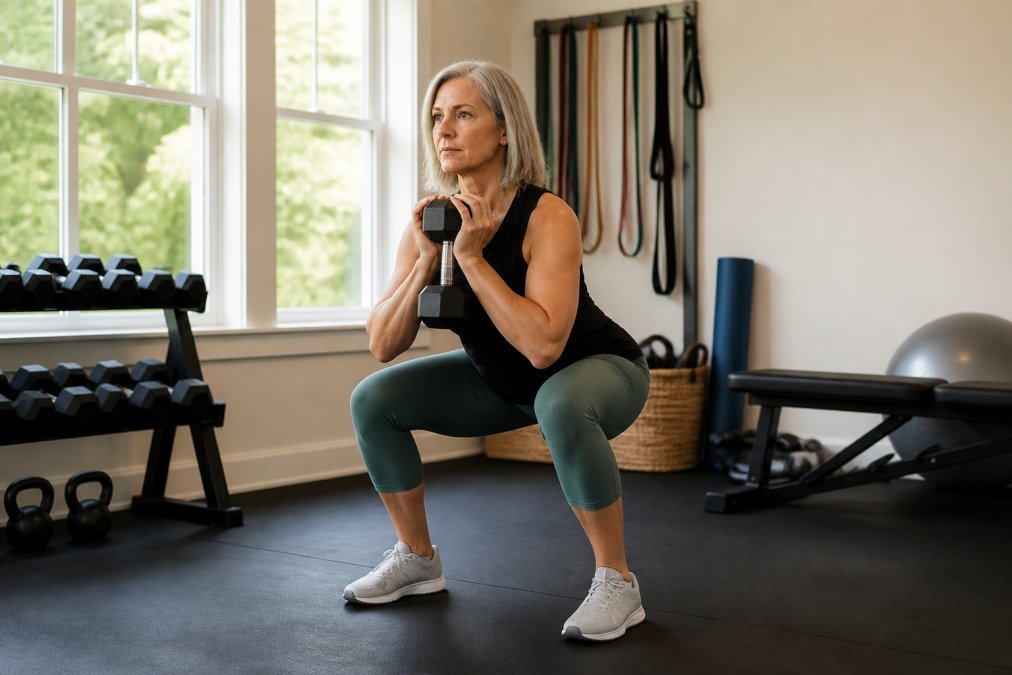
1. Goblet Squat
Hold a dumbbell vertically at chest height, feet shoulder-width apart. Lower your hips back and down as if sitting into a chair, keeping your chest upright and weight in your heels. Drive through your heels to stand back up. Perform 3 sets of 10-12 reps.
Why it matters: Squats build leg strength and bone density in your hips and femur, areas most vulnerable to fractures. They improve balance and functional fitness for everyday activities.
2. Push-Up (Modified or Standard)
Start on your hands and knees or with hands on an elevated surface. Lower your body until your chest nearly touches the surface, keeping elbows at a 45-degree angle. Push back up. Perform 3 sets of 6-10 reps.
Why it matters: Push-ups build chest, shoulder, and core strength. They improve upper body power and posture, which deteriorates without regular resistance work.
3. Dumbbell Row
Hold a dumbbell in one hand, place the opposite knee on a bench. Row the dumbbell up toward your ribcage, squeezing your shoulder blade. Lower with control. Perform 3 sets of 10-12 reps per side.
Why it matters: Rows balance pushing work and prevent rounded shoulders. Strong back muscles support posture and protect your spine.
4. Deadlift (Trap Bar or Dumbbell)
Stand with feet hip-width apart, holding dumbbells at your sides or a trap bar. Hinge at your hips and knees, lowering the weight while keeping your back straight. Drive through your heels to stand back up. Perform 3 sets of 8-10 reps. home strength training.
Why it matters: Deadlifts train the exact pattern you use to pick things up off the ground. They build posterior chain strength and improve grip strength.
5. Plank Hold
Support your body on your forearms and toes, keeping your body in a straight line from head to heels. Hold for 20-60 seconds. Perform 3 sets.
Why it matters: Core stability protects your spine and improves balance.
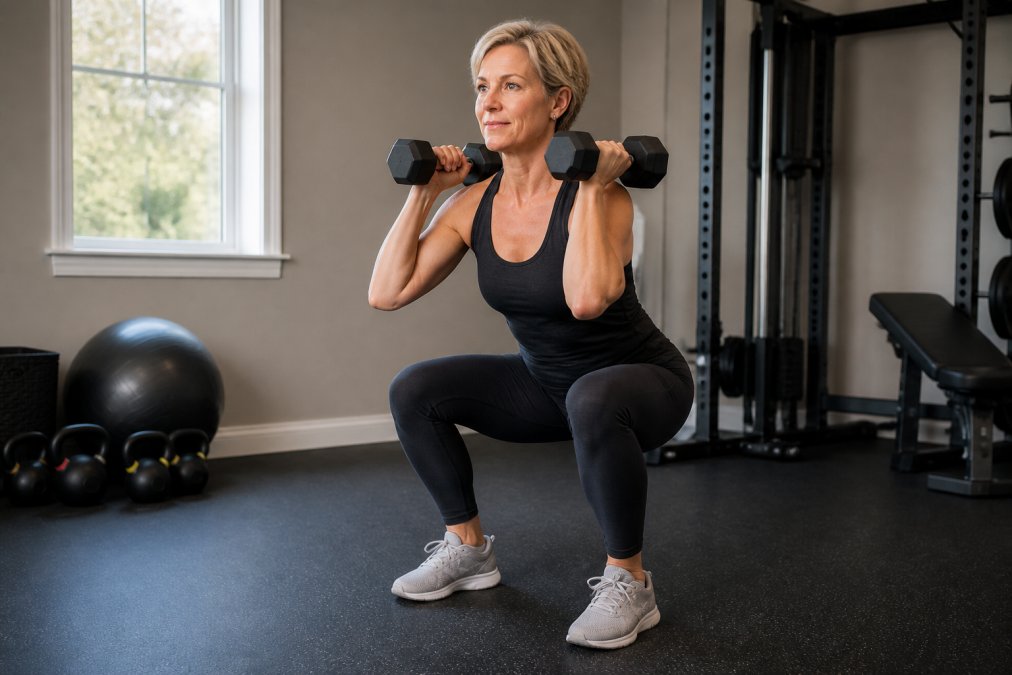
Form breaks down when you’re fatigued. If you can’t maintain proper alignment, stop the set. One perfect rep is better than five sloppy ones.
Master these five movements before adding weight. Most women see significant strength gains in 6-8 weeks of consistent work.
Protein Intake for Muscle Growth After 50
Building muscle requires protein. After 50, your body becomes less efficient at using protein, so you need more to achieve the same muscle-building effect.
How Much Protein Do You Need?
For women doing regular resistance training, aim for 1.2-1.6 grams per kilogram of body weight (peer-reviewed research). A 150-pound woman needs 82-109 grams of protein per day. Spread across three meals and a snack, this is manageable.
Your body’s ability to synthesize muscle protein declines with age. Higher protein intake compensates for this decline. Research shows women over 50 who consume adequate protein while strength training build more muscle and maintain more lean mass.
Practical Protein Sources:
- Eggs: 6 grams per egg
- Greek yogurt: 15-20 grams per 6 oz serving
- Chicken breast: 26 grams per 3 oz
- Fish: 20-25 grams per 3 oz
- Cottage cheese: 14 grams per half cup
- Legumes: 15-18 grams per cooked cup
- Protein powder: 20-30 grams per scoop
Include protein at every meal and snack to distribute intake throughout the day. A protein shake or Greek yogurt snack makes hitting your target easier than relying solely on whole foods.
Creating a Strength Training Workout Plan for Women Over 50
A sustainable plan balances progression, recovery, and variety. Three sessions per week allows adequate recovery while providing enough stimulus for consistent progress.
Weekly Structure:
Monday: Lower Body & Core
- Goblet squat: 3 sets x 10-12 reps
- Dumbbell deadlift: 3 sets x 8-10 reps
- Plank hold: 3 sets x 30-60 seconds
- Glute bridge: 3 sets x 12-15 reps
Wednesday: Upper Body Push
- Dumbbell bench press: 3 sets x 8-10 reps
- Push-up (modified or standard): 3 sets x 6-10 reps
- Shoulder press: 3 sets x 8-10 reps
- Tricep dips: 3 sets x 8-12 reps
Friday: Upper Body Pull & Stability
- Dumbbell row: 3 sets x 10-12 reps per side
- Resistance band pull-down: 3 sets x 10-12 reps
- Single-leg balance work: 3 sets x 20-30 seconds per leg
- Lat pulldown or assisted pull-up: 3 sets x 8-10 reps
Progressive Overload: How to Progress
Progressive overload drives continued strength gains.
| Week | Progression Method | Example |
|---|---|---|
| Weeks 1-2 | Master form with light weight | Goblet squat with 15 lbs |
| Weeks 3-4 | Add 1-2 reps per set | Goblet squat 12 reps instead of 10 |
| Weeks 5-6 | Increase weight by 5-10% | Goblet squat with 20 lbs |
| Weeks 7-8 | Add reps again or increase sets | Goblet squat 4 sets instead of 3 |
| Weeks 9+ | Continue cycling through progression methods | Repeat pattern with new starting weight |
Progress slowly. Two pounds per month is excellent progress. Consistency over months and years matters more than aggressive gains that lead to burnout or injury.
Track your workouts. Write down the weight, reps, and sets for each exercise. This simple habit keeps you accountable and shows progress even on weeks when you don’t feel stronger.
Some weeks you’ll be busier or more fatigued. Reduce volume slightly but maintain the movement pattern. Consistency matters more than perfection.
Low-Impact Modifications and Progressive Overload
Almost every movement has a low-impact version that builds the same strength.
Low-Impact Modifications:
Squat variations when knee pain is present:
- Goblet squat with reduced range of motion
- Wall squat: slide down a wall until your knees are at 90 degrees, hold for 20-30 seconds
- Leg press machine if available
- Isometric squat holds at partial depth
Push-up alternatives for shoulder or wrist pain:
- Wall push-ups: hands on wall, step feet back
- Incline push-ups: hands on a bench or elevated surface
- Chest press with dumbbells: lying on a bench, press dumbbells up
- Resistance band chest press: anchor band and press forward
Row modifications for lower back pain:
- Supported rows: knees on a bench, upper body supported
- Resistance band rows: standing with good posture
- Seated rows: using a machine or band anchored at chest height
- Avoid full deadlifts; use trap bar or elevated starting position
Women with arthritis benefit from higher-rep, lower-weight training. Perform 12-15 reps per set instead of 8-10. Always warm up thoroughly with 5-10 minutes of light movement and dynamic stretching.
Progressive Overload Without Adding Weight:
- Add reps: if you did 10 reps last week, do 11 this week
- Add sets: if you did 3 sets, do 4 sets
- Reduce rest: if you rested 90 seconds between sets, rest 60 seconds
- Improve range of motion: gradually increase depth if pain limited it
- Slow the tempo: take 3 seconds to lower the weight instead of 1 second
These methods build strength just as effectively as adding weight.
Pain during exercise is a signal to stop. Soreness the next day is normal. Sharp pain, joint pain, or pain that worsens during the set means you need to modify or stop that exercise.
Conclusion
Strength training after 50 is about maintaining the strength and independence to live the life you want. Start with consistency over intensity. Two or three sessions per week of proper strength training beats sporadic intense workouts. Focus on form before adding weight. Eat enough protein and get adequate sleep, these are part of your training plan.
If you’re managing hormonal changes, weight concerns, or low energy alongside your strength training, Thrive Health Solutions offers doctor-supervised support through bioidentical hormone replacement, medical weight loss solutions, and personalized wellness protocols. These tools, combined with the strength training foundation you build here, create a comprehensive approach to feeling strong and capable at any age.
BOOK NOW to schedule a consultation and discuss how to optimize your strength training plan with professional guidance tailored to your unique needs.
Frequently Asked Questions
How many days a week should a woman over 50 do strength training?
Most experts recommend 2 to 3 days per week of strength training for women over 50, with at least one rest day between sessions. This frequency allows your muscles adequate recovery time while building strength consistently. Starting with 2 days per week is safe if you're new to resistance training; you can increase to 3 days as your fitness improves. Recovery becomes especially important after 50 because muscle protein synthesis takes longer, making rest days essential for progress.
What should women over 50 prioritize when lifting weights?
Prioritize proper form over heavy weight, as this prevents injury and ensures you're targeting the right muscles. Focus on compound movements that work multiple muscle groups, such as squats and push-ups, to maximize efficiency. Include exercises that improve balance and core stability, which help prevent falls. Progressive overload, gradually increasing weight or repetitions, is critical for building muscle mass and maintaining bone density. Finally, allow adequate recovery time between sessions.
How does strength training impact bone density in women over 50?
Strength training and weight-bearing exercises stimulate bone cells to build new bone tissue, which is especially important after menopause when estrogen levels drop and bone loss accelerates. Regular resistance training has been shown to maintain or even increase bone density, reducing the risk of osteoporosis and fractures. Compound movements like squats and lunges are particularly effective because they stress the bones in your legs and hips, the areas most vulnerable to fractures. Consistency over time produces the greatest benefit.
What is the best way to modify exercises if you have joint pain or arthritis?
Use low-impact variations such as wall push-ups instead of floor push-ups, or seated exercises instead of standing ones. Reduce your range of motion if full movement causes discomfort, and focus on controlled, slower movements. Resistance bands provide gentler tension on joints compared to dumbbells. Warm up thoroughly before exercising and use ice or heat after workouts if needed. Always consult a healthcare provider before starting a new program if you have arthritis or chronic joint issues.
The most common regret women express isn’t about starting strength training, it’s about not starting sooner. You have the knowledge now. The only remaining step is consistency.
This article was written using GrandRanker